Review policy

Due to time pressures, I am unable to commit to reviewing books at the moment. However, please feel free to recommend or discuss by tweeting @MsTick68 or commenting on here. Thank you!

Tuesday, 11 October 2011

Ada Lovelace Day


Image: en.wikipedia.org

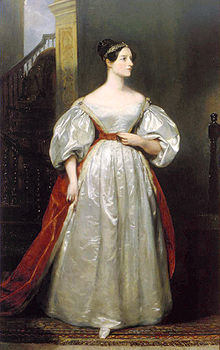
7th October was Ada Lovelace Day. Lovelace (1815- 1852) was the only legitimate child of the poet George, 6th Baron Byron, and his wife Anna Isabella (known as Annabella) Milbanke, nicknamed by her husband "the Princess of Parallelograms" due to her love of science and mathematics. Ada's parents had a very unhappy marriage and they separated a month after her birth. Unusually for the time Ada was brought up by her mother, and her father made no attempt to enforce his legal parental right. Ada had no relationship with him.

Annabella was obsessed with educating out what she saw as Ada's possible inheritance of Byron's instability and madness, and she did this by focusing Ada's education on "rational" subjects such as mathematics and logic. Through Mary Somerville , who taught her mathematics, Ada met Charles Babbage, the creator of the "analytical engine"; a machine designed to analyse mathematical formulae. Ada translated an Italian article on the engine and added notes to it. She wrote an alogarithm for the machine to compute Bernoulli numbers (although the machine was not completed during her lifetime) and is therefore considered the world's first computer programmer.
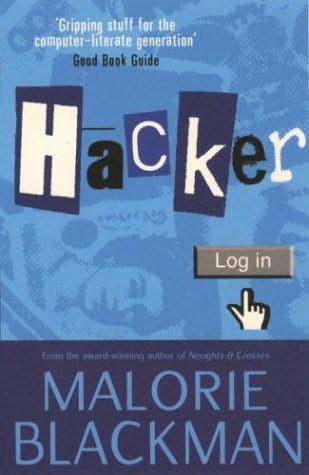

Image: fantasticfiction.co.uk
This made me think about a book I read many years ago as a young teacher: Hacker, by Malorie Blackman, probably best known for her astonishing Noughts and Crosses series, but also the author of some great picture books, books for younger readers and novels for older children.

Hacker opens with Vicky and the rest of her Year 8 class (including her adopted brother Gib and his annoying friend Chaucy) waiting to take a Maths exam. Inside the exam hall Vicky notices several people cheating, including her friend Maggie. Vicky has a programmable calculator, and writes a programme to work out interior and exterior angles and areas of shapes. Unfortunately since she finishes her exam in 20 minutes instead of two hours, her teacher assumes that she is the hacker that stole the Maths exam. She is given a letter by the head teacher to take home.

However, on returning home, she and Gib discover that something far more serious than cheating at an exam is concerning her parents. Her dad has been accused of transferring one million pounds from the bank where he works to his own account. Vicky and Gib set out to prove his innocence by hacking into the bank; however this puts Vicky in terrible danger from the real thief.

I loved this book. Not only is it a thrilling adventure, but Vicky and Gib's relationship is very believable, as is the ebb and flow of "tween" friendships. Vicky is mixed race, as is her adopted dad, and the detail of her darker skin making her feel as though she doesn't quite belong to the rest of her family rings very true. Identity and ethnicity are not the most important aspects of this book, but it is great to see that the problems needing to be solved in this story. And as children pick up the ideas of "girls' subjects" and "boys' subjects" so early, it is very positive to have a book aimed at 8+ featuring a girl computer programmer! It is unfortunate that the computing aspects of this book have dated, but I would hope that the thriller plotline and believable characters would carry young readers through.

This book is a good one for teaching Primary children about Ada Lovelace and her importance in the history of computing.

Thursday, 6 October 2011

About a Girl

The Bookseller recently reported what seems to be a downturn in sales of titles by top selling women authors, which was reported in The Guardian as "the death of chick lit". At the same time, it seems that children's books are outperforming adult fiction, which is good news for children's book week. So what is there for girls to read ? Well, I recently read three books that teenage girls should enjoy.

Image: bookdepository.co.uk
Lauren Laverne, BBC 6Music DJ, TV presenter and erstwhile indie pop star with Kenickie, (and they were as much fun to see live as they look!) writes about 15 year old Candy Caine, who lives in a small seaside town. She and her best friend Holly hang out in the cafe/ record shop The Bluebird eyeing up the gorgeous Dan, and hatch plans to rid Candy's glamorous mum of her boring fiance and to find Candy's birth father- could he really be 90s indie star Nathan Oxblood? To placate Candy, her mum and Ray buy her a battered old cherry red Gibson SG guitar, and when Candy strums a B chord, out pops a supernatural being called Clarence B Major, to assist her. Candy and Holly form their band, the Broken Biscuits, and their plan for finding Candy's dad comes together. It's very funny book, encapsulating embarrassing teenage party behaviour, feisty octogenarian Gladys, and lots of music references (as you'd expect from Lauren's encyclopedic knowledge). One rainy day I'll make a playlist! Here's Lauren talking about her "indie fairy tale". I've passed a copy on to a friend's 13 year old bass playing daughter, who loved it as well. I can't wait for the sequel, although of course Lauren has been rather busy with baby no. 2... but come on, Lauren, please!

Image: Jessieheartsnyc.wordpress.com
I read Keris Stainton's Jessie Hearts NYC while commuting. This is always dangerous; fine on my way ti work since it is at the train's final destination, but more tricky on my way home, and I nearly ended up in North Essex on more than one occasion. This is an interesting book. English Jessie and her best friend Emma head to New York to visit Jessie's playwright mum, hoping to forget her awful ex boyfriend. New Yorker Finn is in love with his best friend's girlfriend, but also needs to find a way to tell his dad that he doesn't want to study business at University and go into his firm. Jessie and Finn could be perfect for each other; as long as they get to meet... This book has three protagonists: Jessie, Finn and New York City itself. I loved it; the city is evoked perfectly, and the dynamics (between Jessie and her mum, Jessie and Emma, Finn and his family, Finn and Scott, Finn and Sam, Scott's girlfriend) are pitch perfect. Keris very kindly sent me a copy of the book, but this is my honest impression of it. Here is one of favourite New York- related songs: Belle and Sebastian's Piazza New York Catcher. Incidentally, also one of the best gigs I've ever been to!

Image: thebookpeople.co.uk
It's a truth universally acknowledged that many teenage girls dream not of becoming a footballer or rock musician themselve, but becoming a WAG (wife and girlfriend) of one. Michelle Gayle should know; she was married to footballer turned pundit Mark Bright (although having played Hettie on EastEnders and been a pop star it could be argued that he was the BAH- boyfriend and husband).  Her novel Pride and Premiership is about seventeen and a half year old Remy Bennet and her gorgeous older sister Malibu, who are both beauticians working in the same salon. Malibu has devised a WAG's charter, which includes such gems as "Pretend you don't know he's a footballer" and "Never dispute a thing his mum says"- since all footballers worship their mums. Written as Remy's diary, the book charts her meeting with footballer Robbie Wilkins (he doesn't play for a premiership team, but he's gorgeous) and her relationship with him. Can she trust him on a lads' holiday to Ayia Napa? has he really broken up with his ex girlfriend? Can she believe his excuses for not contacting her for long periods? And is Malibu following her own rules? It's a fun read, more Bridget Jones than Pride and Prejudice; Remy's voice is believeable, and Michelle Gayle workshopped the novel with a number of groups of girls; perhaps for me this is where it doesn't quite work: the message overpowers the medium. It feels a little contrived. However, I really rooted for Remy and found myself willing her to dump Robbie and believe in herself more in parts of the novel. Here is a clip of Michelle reading from Pride and Premiership.

I'd recommend all these books for 14+. They're fabulous! The title of this post is from one of my favourite Nirvana songs.

Sunday, 2 October 2011

Banned Books Week

This week (24th September to 1st October) has been Banned Books Week. Every year in the US, hundreds books in the public (state) school system and in public libraries are "challenged", but many are never reported. During Banned Books Week, the public was challenged to read banned and challenged books. I decided to read Young Adult novel  Bless Me, Ultima by award winning Mexican-American author Rudolfo A Anaya.

Image: msu.edu
This is the story of Antonio, a seven year old Chicano boy growing up in New Mexico during World War Two. His brothers are away in the army, and in the early part of the novel the loss of young men is a palpable background to the story: the mothers in mourning going to Mass, and then a traumatised veteran kills the sheriff. Antonio's parents, a farmer's daughter whose hopes for respectability through Antonio's becoming a priest, and his father, former vaquero (mounted livestock herder, similar to a gaucho or cowboy) turned road mender, have conflicting dreams for the family. His mother wants to stay close to her family; his father hopes to move to California once his older sons return. It is into this atmosphere that Ultima, the wisewoman and healer, comes to stay with the family.

As soon as she arrives, Ultima recognises something within Antonio, and becomes his mentor in curanderismo, the healing arts. She teaches him not only the herbs and their properties, but also how to respect them. Antonio has vivid dreams and deep sympathies, which reflect not only his learning as a curandero, but also the conflicts of Catholic teachings and traditional beliefs, and the conventionality of his mother's family and the freedom loving nature of his father. Then his uncle Lucas is cursed by the three bruja (witch) daughters of Tenorio Trementina. Antonio not only witnesses Ultima break the curse, but also internalises Lucas' illness, leading to his recovery. However, Tenorio becomes determined to destroy Ultima and anyone protecting her. Antonio witnesses a number of deaths as a result.

Bless Me, Ultima contains swearing both in Mexican Spanish and in English, and what could be taken for mocking of Catholic religious practices through the children re-enacting confession with Antonio as reluctant priest. However, there is nothing more shocking in it than in Dylan Thomas' Under Milk Wood scenes with children. I was unsurprised to see that the principal who removed the book in Norwood, Colorado later admitted that he had in fact not read it. I am at a loss to find where the parents of Fayetteville, Arkansas find the book irreverent. The scene where the children are re-enacting confession, as I mention above, shows that Antonio is an unwilling participant and feels uncomfortable doing so; Anaya is definitely not approving of this behaviour.

In my opinion the changes to the UK education system, with more state-funded independent schools and giving more "freedom" in the curriculum could lead to similar challenges to literature here. In my opinion this should be resisted. Parents should and do have the right to disapprove of books for children; they have every right to control what their children read at home. However, no parent should have the right to control what other children read. Literature exists to provoke, challenge and make us think. It should be discussed, studied and its merits should be judged. How else will a child in the City of Birmingham, UK know about the lives of children in Birmingham, Alabama, or children in East London, UK know about children in East London, South Africa? "Only connect", as EM Forster says in Howards End. Through reading, that is what we do.

An appropriate song: La Bruja by Lila Downs, an amazing Mexican singer.

Sunday, 25 September 2011

Trotting ponies, swooping dragons

Like many other pre-teen girls, I was obsessed with pony books, and the idea of riding. I grew up near riding stables, and later my more enterprising younger sisters got free lessons in return for mucking out and other chores, but by that time I had become more interested in other things. However, I read a great many pony books between the ages of 9 and 11, and I particularly liked Follyfoot and other Monica Dickens pony books about the farm and ponies. I recently re-read it, and while I found some of the snobbery a little hard to take (the nouveau riche plumbers' wife with gnomes in her front garden and secretaries from London who don't know how to look after ponies are disapproved of; the poor-but-natural rider Toby is semi-adopted as One Of Us) the unabashed physicality and resourcefulness of the girl characters is celebrated; something they have in common with boarding school stories. I mentioned on Twitter that I was reading Follyfoot, and had people tweeting me the theme tune to the TV series, which I remember only vaguely- we couldn't get ITV on our telly until a new mast was built in the mid 70s- but I am determined to find a copy of it!


Image: bookdepository.co.uk


I was reminded of pony books by reading a couple of books about dragons: Lucinda Hare's Dragonsdome Chronicles, The Dragon Whisperer and Flight to Dragon Isle. The story of Quenelda, illegitimate daughter of Earl Rufus DeWinter of the Stealth Dragon Services and an unknown mother, it combines the best elements of pony stories (the close relationship between child and animal, the power that relationship confers and the feeling of freedom and speed that riding invokes) alongside magic and an epic battle between the Seven Seas Kingdom and the Goblin Hordes. It reminded me strongly of both JRR Tolkein's The Hobbit and Harry Potter, with the themes of a timid outsider (Root Oakley, Quenelda's squire and friend, is a gnome who is terrified of dragons) overcoming his fears and showing heroism, and a slightly arrogant protagonist learning patience and tolerance through a less able friend. There is a terrible betrayal from a character whose arrogance has led him to pursue personal power, corrupting him. The physical hard work of looking after animals and the commitment needed to do so properly is demonstrated through the contrast of Quenelda with her vain and selfish half brother, Darcy, who is nearly killed through his unwillingness to listen to the Dragonmaster. Although the setting is in the fantasy Seven Seas Kingdom, the use of Scottish phrases such as "haar" for a sea fog, and the descriptions of the the Sorcerer's Glen remind me strongly of Kilchurn Castle on Loch Awe.


Image: Lawrence Warren from bbc.co.uk

At Haringey Children's Literature Festival I met author and storyteller Margaret Bateson-Hill, author of some gorgeous picture books and of Dragon Racer and Dragon Racer- Legacy of Fire.


Image: amazon.co.uk
Joanna Morris is an ordinary school girl from Brixton, South London, who is waiting for her brother opposite Lambeth Town Hall when she notices a small silver dragon crawling down the outside of the building. Excalibur has been bred by the Brixton Dragon Caves to race and compete against the rival Brighton Pavillion Dragon Caves, owned by the sinister Marcus King, who will stop at nothing- even genetic mutations- to win. Like Quenelda, Joanna has a powerful connection with the mischievous XL, and they must train hard and overcome adversity in pursuit of compete. It's a great, exciting read, but for me lacked the intrigue of The Dragon Whisperer; perhaps the modern day setting means that it inevitably misses the epic sweep?

I would recommend all these books for confident readers of 8+. I know that Zoe from Playing By The Book's 6 year old loved having The Dragon Whisperer read to her, to the extent that she is considering dressing up as Quenelda for Children's Book Week!

Friday, 16 September 2011

Scary Fairies and Borrowers


source: totalfilm.com
 Just before I went on holiday I made my second-ever solo cinema visit to see Studio Ghibli's adaptation of Mary Norton's The Borrowers, Arrietty. Watch the trailer here. It is a beautifully animated film, which takes its time telling the story and lacks the manipulative cuteness and knowingness of recent US animation such as Hop. The film tells the story of the book fairly closely, although it is updated; the book, published in 1952, opens with an old lady telling a little girl a story from her childhood, which we can assume was pre- World War 1. In Arrietty, the story is set in contemporary Japan. A boy, Sho (he is unnamed in the book) comes to live with his aunt. He sees a cat chasing something; he investigates and catches a glimpse of a tiny girl collecting leaves. This works well in the context of the film, as it demonstrates Arrietty's adventurous nature without having to tell us about it. The characters are essentially the same: the Borrowers, Pod, Homily and Arrietty Clock, the great aunt, the cook and the boy, although in the book the great aunt is a very elderly lady who spends most of her time in bed, enjoying glasses of Fine Old Pale Madeira. It is down to her befuddled state that Pod is able to borrow from her.

The terrible tedium of Arrietty's life before she meets the Boy is shown rather comically, I felt, in her excitement at washing day when she can go and hang the washing out by the grating. Her mother Homily in the film is more comical and loveable than the fretful, nagging and fearful character she is in the book. Arrietty's shock at the discovery that, instead of the rare creatures she assumes, "human beans" are in fact numerous and Borrowers are rare is shown in a powerful and affecting moment of stillness.

A big difference (and this is inevitable) is the lack of the framing device of the old woman narrating the tale to the little girl, and an unreliable narrator telling us about that: we are told very firmly that the little girl is not the "me" sitting and listening to the story, and this emphasises the uncertainty at the end of the book, when Mrs May isn't certain that her brother hasn't been making up the story all along (we're told he is very imaginative), since the handwriting in Arrietty's Book of Memoranda is so similar to his.


Source: waterstones.com

Michelle Harrison's The Thirteen Treasures reminds me strongly of The Borrowers, although the relationship between fairies and Tanya is not the generally benignly symbiotic one between the Clock family and the Human Beans; these fairies are malevolent, jealous and threatening. Like the Boy in The Borrowers, Tanya is sent to live with an elderly relative (this time her distant and seemingly unloving grandmother) in a remote country house. Tanya has a secret: she can see fairies. And they can see her. They torment and threaten her, and she is blamed for the damage they do to her possessions and house. Her mother can't cope any longer, so she is taken to live with her grandmother in Elvesden House in Essex. However, there is also a secret connected to this house, involving the mysterious disappearance of a young girl many years before, and if Tanya and Fabian, the caretaker's son, don't solve the mystery, there is a danger that history may repeat itself.

I would recommend the film to 6 year olds+; it isn't scary, but it may not hold the attention of younger children. I would suggest reading The Borrowers to 7+. It isn't a long book by modern standards but the narrative is quite complex; advanced readers 8+ should love reading it themselves. The Thirteen Treasures is a fantastic book for confident readers of 9+.

Monday, 29 August 2011

Holiday reading

Earlier this month, I went to Lake Garda in northern Italy on holiday. The friends I went with are keen climbers, mountain bikers and kayakers, and unfortunately I have a shoulder and back problem which means that the most strenuous activities I could do were walking and swimming in the pool. However, this enabled me to do some reading while they were off being active!


The Knife of Never Letting Go by Patrick Ness was the choice of the children at the book club I hope to run, and I must say I was a little nervous when I first started reading it, since although the club is for 8-12 year olds, most of the members are 8-10. Todd Hewitt is about to turn 13, and in his world, he will become a man. Todd belongs to a pioneering community of settlers on another planet, and like the Pilgrim Fathers, the original settlers were escaping what they perceive as a a sinful world. Todd grows up in Prentisstown, totally inhabited by men. He has been told that germ warfare released by the indigenous people of New World planet (the Spackles) killed all women, including his mother, but the only side effect it had on men was making all their thoughts audible. Todd appears to be growing up in a world with no secrets. Even dogs and men can read each others' thoughts.


Image: walkerbooks.co.uk
 Then, in the swamp, Todd encounters a pocket of silence. Living in a world of constant noise from others' thoughts- really well depicted in the book as overlaying sentences of text- this is a new experience for him, and unfortunately not one he can keep secret: Mayor Prentiss uses thoughts as a way to control his population. He also encounters the preacher, Aaron, who attempts to provoke a fight with him. On returning home, his foster fathers Ben and Cillian realise what has happened and perceive the danger Todd is in. They have been planning Todd's flight for 11 years. They give him Cillian's hunting knife, Todd's mother's diary, a map and a bag of supplies, and Todd and his dog, Manchee, must escape. However, Todd cannot read: Mayor Prentiss has banned books and shut down the school, so Todd discovers only by degrees that everything he has known about his world is a lie.

This is an amazing book, which reminded me in many ways of Russell Hoban's Riddley Walker, particularly in the narrative voice and in premature adulthood thrust upon Todd. I was a little alarmed that the bookclub would find it too violent, and that the (very mild) references to sex might be too much for them, but I needn't have worried: these aspects seem to have passed them by. They found the death of one of the characters more upsetting (and I won't spoil it by saying who). One boy in fact carried the book around for days, even reading it at playtime at school!

image: nnedi.com
The second book was Nnedi Okorafor's The Shadow Speaker. Set partly in Niger in 2070 and partly on Ginen, the planet where Okorafor's earlier work Zahrah the Windseeker is set. Post-nuclear event, the portal between the world of Ginan and Earth has opened, and there are metahumans, such as Ejimafor who can speak to shadows. Her father was a local politician, who imposed a strict interpretation of Islam on Ejii's town. He enforced veiling for women, and took other wives, before throwing Ejii and her mother out. Hypocritically, however, he still had Ejii sitting on the platform at a political rally when the ruler of Ejii's state, Jaa (who is from Ginen) arrives and beheads him. Ejii hated her father, but still feels both attracted to and repelled by Jaa. However, when she arrives at Ejii's house with news that the inhabitants of Ginen intend to attack rather than have the corruption and pollution of Earth damage their planet, Ejii is determined to go with Jaa and help. Her mother forbids her to leave, so she sneaks off in the night with Onion, her talking camel. On the way she encounters talking desert cats, murderous sentient sandstorms and a boy who was sold into slavery in a cocoa plantation by his own family, who has powers of his own.

This is a good book, but not a great one; it is interesting to see how much better Akata Witch is, where Okorafor appears to be keeping her imagination a little more under control, leading to a much more coherent narrative in my opinion. However, a less-good book by an amazing writer like Okorafor is far more worth reading than anything by a mediocre writer, and it gripped me from beginning to end.

Image: bookdepository.com

The third book I read was The Last Elf by Italian author Silvana De Mari. It is a little obsession of mine, reading on holiday a book written by an author of the country I'm visiting. We publish very few children's books in translation in the UK, sadly. Yorsh the elf is discovered by a woman and a hunter as a little child. Elves are both despised and feared in his world, and the trio are imprisoned by the dictatorial leader of a town where they are discovered. In prison, Yorsh discovers part of a prophesy which implies that his destiny, as the Last Elf, is tied up with that of the Last Dragon, and they travel to the abandoned library where the dragon lives.

Some years later, a girl named Robi is in an orphanage in the town where the trio were imprisoned. The overseers of the orphanage abuse and underfeed the children, and set them against each other. However, one day when the children are working in the fields picking fruit, they see a dragon flying overhead, with a small figure riding it. How is Robi's destiny tied up with these two?

This novel is more gently paced than Young Adult novels in English. It has a dreamlike quality which was very enjoyable, although in places I felt it lacked impact. Unfortunately it seems that no other De Mari novels have been translated; but I'll be seeking out more translated works than I have so date. My horizons need broadening!

I'd recommend all these novels for confident readers of 12+.

Tuesday, 16 August 2011

The Magical Detectives: review

Image: Waterstones.com

Brian Keaney's The Magical Detectives is set in the small town of Bridlington Chawleigh. Otto Spinoza's mother runs a bookshop. She is a terrible worrier, and the only thing that pacifies her is a packet of biscuits. One day she is worrying more than usual, and Otto pops to the shop to buy a packet. But when he gets back, she has disappeared, leaving a message HELP ME spelled out in magnetic letters on the fridge. What is Otto to do? On the community notice board in the shop he notices a card advertising the services of Maximillian Hawksmoor, Magical Detective Agency, and with Maximillian's services, and the accidental help of classmate Juliet Pennington and her cat Cornelius, he must travel through a magical portal in the grounds of a stately home to another world to rescue her.

This is the promising beginning of a series (I read and reviewed the second in the series for The Bookbag) and could be read and enjoyed by a confident reader of 7+. For children who like their mystery stories to have a touch of fantasy, magic and a few sherbert lemons, this would be a great, fun read. Brian is appearing at the Lewisham Literary Festival in September.

I would like to thank the Brian Keaney for sending me a copy of this book; however this review is my honest opinion.